 ck
ck Don't Be a D✱ck
Ninety-nine everyday ways to be more human — and build a world where everyone belongs.
The book is nearly here. It's warm, it's practical, and yes — the title is doing exactly what you think it's doing.
Inside are ninety-nine small, everyday ways to be a little more human: kinder, more curious, more aware of how we land on other people. No lectures. No shame. Just invitations — built from more than two hundred honest conversations with people across nineteen countries.
What's a way?
A way is a small invitation. Not a rule, not a framework, not homework — just one everyday thing you might do a little differently, told straight and kept short. Nine of the ninety-nine are free to read — here's one, exactly as it appears in the book:
Build the day so disability isn't an afterthought bolted on at the end.
I used to watch organisations do this with the best of intentions and the worst of timing. The conference is booked, the agenda is set, the rooms are chosen, and then, almost as the doors are about to open, someone says, "Oh, do we need to think about access?" And suddenly there's a flurry: a ramp located, a sign-language interpreter chased down at short notice, a quiet corner improvised because nobody planned for the person who can't sit through eight hours of fluorescent noise. It gets done, often heroically. But it always carries the same quiet message to the people who needed it — you weren't part of the plan; you're the patch we applied once we remembered you.
Esi Hardy, who trains organisations on disability inclusion, names what's really going on underneath that scramble. Her line on it: "when they're building these things without talking to disabled people and talking with people with lived experience, they're not thinking at all… It's about we know we have to do it legally. Therefore, we've done it. Let's move on and do something else." That's the tell. Access treated as a legal box to clear on the way out of the room, rather than a group of people to plan around on the way in.
Here's how I've come to see it. Accessibility designed in at the start is invisible and dignified. Accessibility bolted on at the end is visible and slightly apologetic, and everyone can feel the difference even when nobody says it aloud. The captions that were always going to be there feel like hospitality. The captions arranged in a panic the night before feel like an exception being made: for them, because of them. Same captions. Completely different welcome.
So I try to ask the awkward questions early, when they're cheap to answer. Before the venue is signed, not after. When can someone using a wheelchair move through this space as easily as anyone else, not by a separate side entrance, but with everyone? Where's the seating for someone who needs to step out and come back without a performance? What happens for the person who processes information by reading rather than hearing? None of this is exotic. It's just earlier.
The barrier was never really cost or capability. It was the running order in our heads, the habit of treating disabled people as a special case to be handled rather than guests to be expected.
And when you get the running order right, something shifts that goes well beyond compliance. Lyndsay Mitcheson knows that from the inside. An above-knee amputee, she founded Neo Walk and started hand-making acrylic walking sticks in colours bright enough to turn a piece of medical kit into something people actually want. "people were coming up to me and saying, [I love] your walking stick. It's amazing. Instead of what happened to you or what's wrong with you?… it's switched the focus from my leg to I like your stick. And that was the magic." That's what good design does. It moves the conversation from what's wrong with you to I like your stick. Access built in from the start does the same thing for a room: it stops announcing someone's difference and starts making them feel expected.
Anyone steering a team, an event, or a product sets that running order. You decide whether access lives in the design brief or the panic list. I've been the person scrambling for a ramp, and that scramble is its own teacher. But the fix isn't more effort at the end. It's a quieter question at the beginning: who is this built for, and did we assume them in from the start? Do that, and people arrive knowing they were expected all along.
So build the day for everyone who's coming, including the ones you haven't met yet.
Ninety more where those came from — see all the invitations →
Way of the day
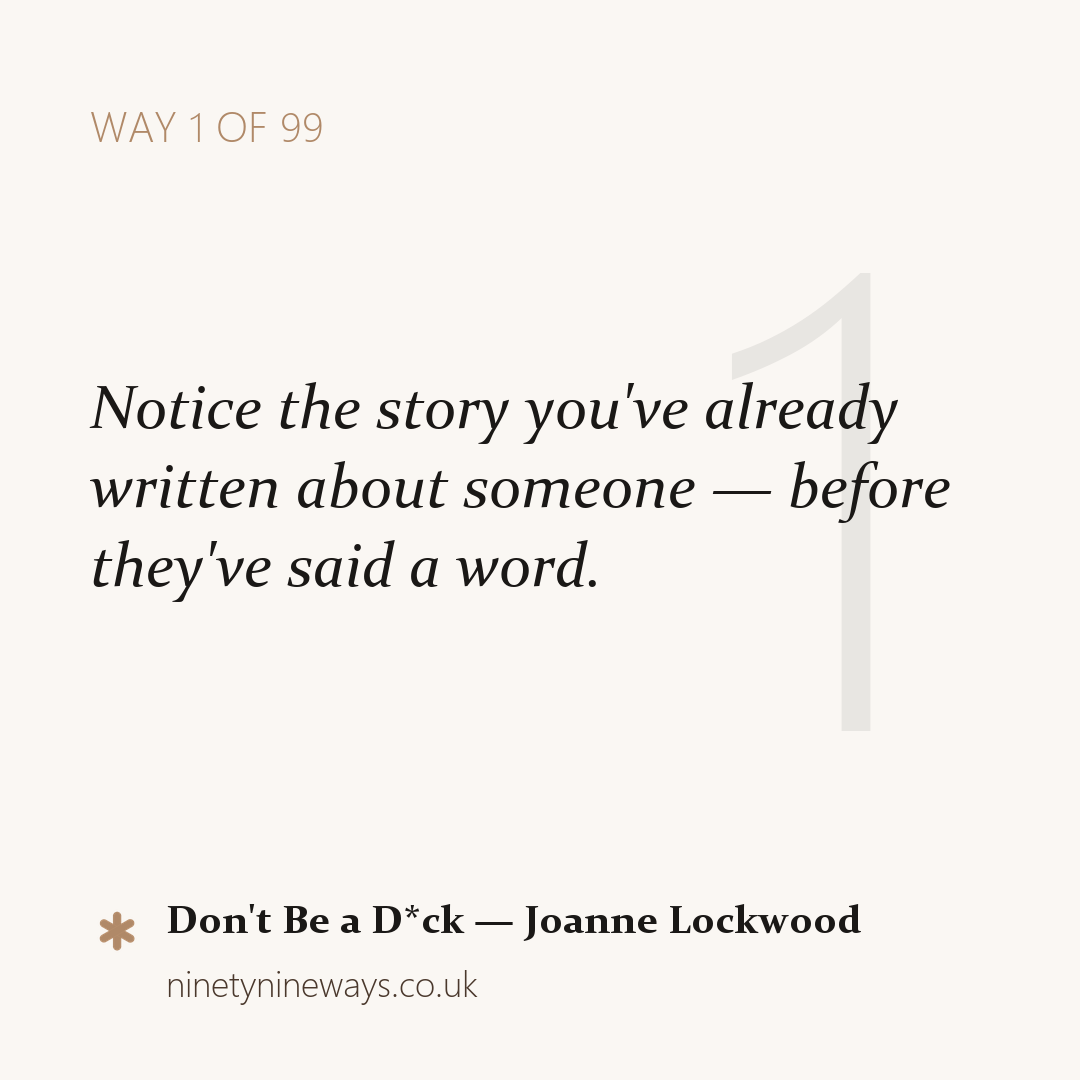
There's no right order — the book says dip in anywhere. Today, everyone gets this one:
Not thought up alone
This book is built from more than two hundred conversations on the Inclusion Bites podcast — with guests from nineteen countries and six continents. More than ninety of those voices are quoted in its pages, by name, with their blessing. Meet the voices →
Nine of the ninety-nine, free.
The nine free ways above, beautifully typeset, in your inbox — plus first word when the book lands. Leave your email:
No spam. That wouldn't be very human of me.
Prefer a conversation? Email jo.lockwood@seechangehappen.co.uk — it's read by an actual human.